Cats Can Has Grammar
If you spend any time at all observing net culture, then you’ll have been unable to miss the recent explosion in popularity of lolcats. This relatively recent phenomenon is the convention of taking pictures of cute animals, most frequently cats, and overlaying absurdist captions on the images.
The core behavior has existed for some time; “Image macro” is a generic term for this kind of folk art, and cats have always featured heavily in these types of Internet in-jokes. But a few distinct categories have sprung up that have helped amplify and popularize the phenomenon.
- I’M IN UR *XY*ing your Z.** This construct, based on i’m in ur base, killin ur d00ds has morphed into a catch-all structure for annotating cat pictures.
- Invisible Item. Variations on the seminal Invisible Bike, these are images of cats, usually in midair, with captions that prompt us to fill in imaginary objects or actions that complete the scene. There’s something brilliant to these images, speaking to our mind’s ability to intuitively extrapolate unseen details.
- Kitty Pidgin. And finally, the newly dominant lolcats, of the family I Can Has Cheezeburger? These seem to be spawning nearly infinite variations, and have exploded in popularity since being named “lolcats” instead of the more general “image macro” or “cat macro”.
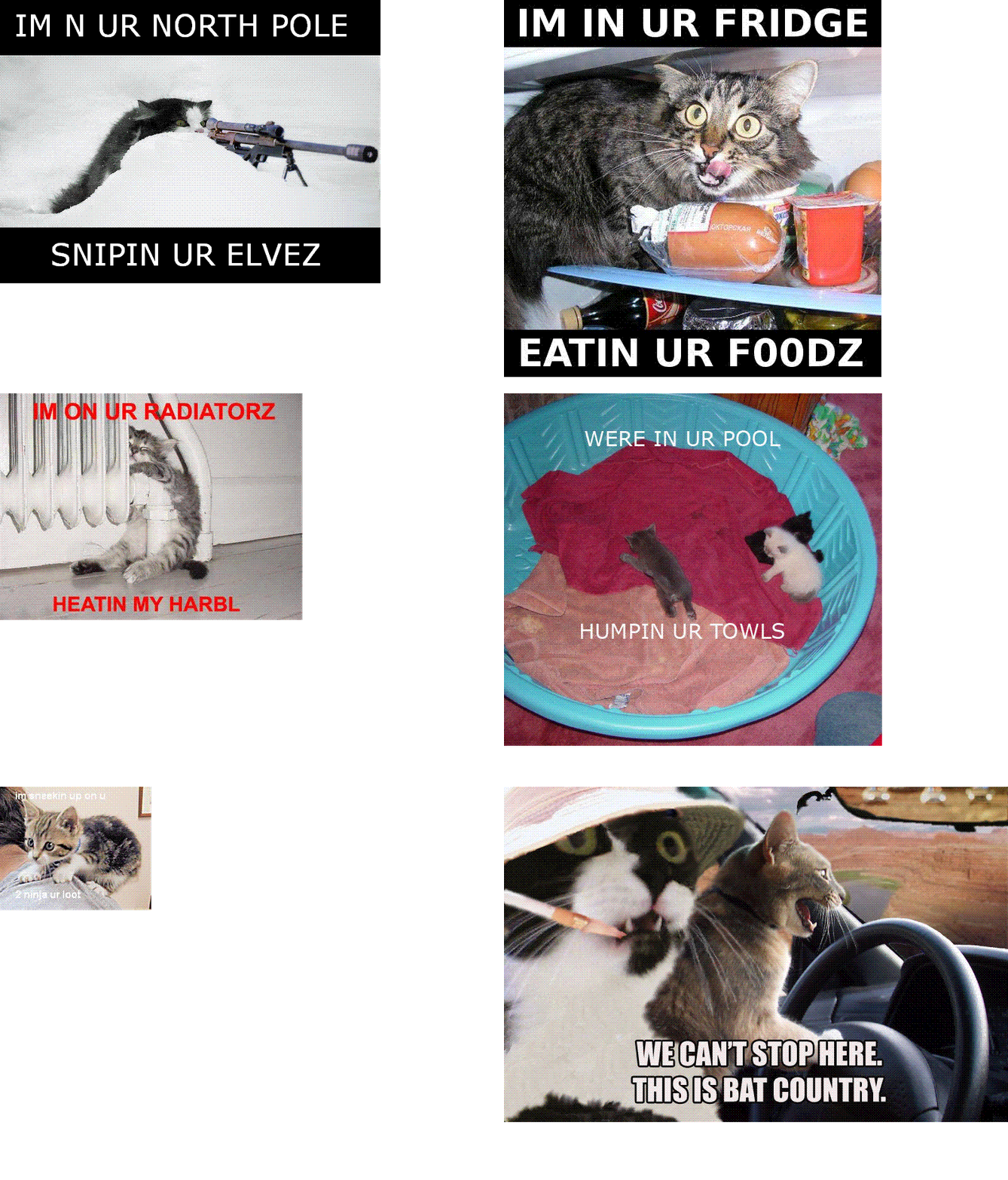
The rise of these new subspecies of lolcats are particularly interesting to me because “I can has cheezeburger?” has a fairly consistent grammar. I wasn’t sure this was true until I realized that it’s possible to get cat-speak wrong.
Incorrect kitty pidgin jumped to my attention the first time I saw a reference to Dune being used with a lolcat image. The caption on the linked version of the image, “The spice must flow.” is fine, if not particularly cat-like. But the caption on the version I saw first was much more verbose: “I are dunecat. I controls the spice, I controls the universe.” Besides being an awkward attempt at overexplaining the punchline (I’ve never read Dune or seen the film, but the joke is obvious) this was just all wrong. The fact that we can tell no cat would talk like this shows that kitty pidgin is actually quite consistent.

I was having a conversation with Ben and Ben a few weeks ago where I suggested this consistent grammar for lolcats could be a “cweeole”. Knowing a bit more about such things now, I realize this isn’t a creole but more likely a pidgin language, used to help cats talk to humans. And since “pidgin” is already a cutesy spelling of a mispronunciation, there doesn’t seem to be any really cute way to rename it to reflect its uniqueness. “Kitty pidgin” might be the closest thing we have to a name for this new language.
There’s a consistent visual vocabulary to the construct, as well. If it ain’t Impact or Arial Black or some other nondescript sans serif font, it ain’t lolcat. White letters with a black outline are a must. But codifying a design guide for lolcats is well beyond my abilities.
Unfortunately, the evolution of these grammars online can be very difficult to track down; This kind of nascent web culture is generally frowned upon by Wikipedia (witness the deletion of the I’m in ur base article since the Ask MetaFilter thread just a few months ago) and there are no other sites designed to collect definitive collaborative reference material. It’s going to take time to document kitty pidgin with any degree of accuracy.
I’ve just started bouncing the idea of kitty pidgin off of Erin and Grant, two of my favorite word experts, but I’m confident that someday we’ll have kitty pidgin dictionaries. Perhaps we’ll even get all the niceties that Klingon and Elmer Fudd-speak enjoy, like a Google translation, a Microsoft Word dictionary, or a cat-native version of the Bible or Shakespeare.
I has a links
Okay, go out and look at some of the finest kitty-related content:
- Kitty pidgin’s already made its way into business communications — our last LiveJournal news post had lots of references to our team-up with Photobucket under the heading “We has a Photobucket”. I was especially proud of my quick-and-dirty PhotoShop work in that thread.
- Gordon McNaughton’s created a LolCat Build(e)r. A fantastic and essential app, though I have to take issue with the use of CamelCase InterCaps in the word “lolcat”.
- Cute Overload is likely the seminal site for taking the “cute culture” aspect of online behavior seriously. Meg Frost always has fun with the content, but I haven’t seen any high-profile definitive collections of these genres that predate Cute Overload.
- Choire Sicha is a genius, but if you needed more proof, you can now just head to lolgays.com to be redirected to his Gawker post on lolgays. It’s exactly what you think it is.
Update: This post has gotten an amazing reaction, and inspired a number of follow-up posts, including a look at MeowChat and PetSpeak and my thoughts on Cats, Comics and Closure. I’ve also collected responses to the popularity of lolcats in a few posts:
- Inadvertent Lazymeme Clearinghouse Lamentations shows some of the best early responses to the meme
- Pidginholed shows lolcats gaining popularity in mainstream media, including a Houston Chronicle cover story
- And perhaps most amusingly, The LOL Street Journal marks the milestone of lolcats making their way, yes, into the Wall Street Journal.
- If you enjoy this sort of stuff, you’ll want to join me at ROFLCon, an event being held at Harvard just to celebrate silly online memes like lolcats.